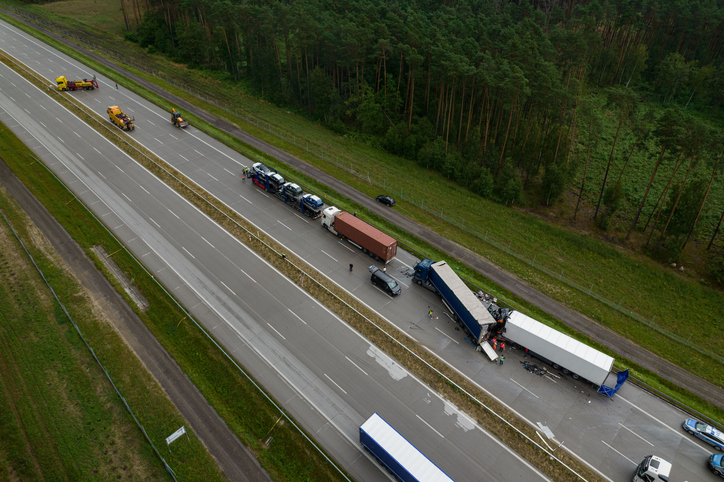
Multi-vehicle highway accidents are among the most complex types of motor vehicle collisions in Mississippi and Tennessee. These crashes often involve multiple drivers, conflicting accounts of what happened, and overlapping insurance claims. Because of this complexity, determining fault is rarely straightforward.
Insurance companies conduct detailed investigations to assign liability, but their evaluations are not always neutral. Understanding how fault is assessed can help injured individuals better understand the claims process and what factors may affect their case.
Why Multi-Vehicle Accidents Are So Complex
When more than two vehicles are involved in a crash, determining the sequence of events becomes more difficult. A single chain-reaction collision can involve:
- Rear-end impacts
- Side collisions
- Secondary crashes caused by traffic congestion
- Multiple points of contact between vehicles
Each driver may have a different version of events, and physical evidence may not clearly show the full timeline.
How Insurance Companies Begin Their Investigation
Insurance companies typically begin by collecting basic information such as:
- Police reports
- Statements from drivers
- Witness accounts
- Photos of vehicle damage
- Crash scene documentation
From there, they attempt to reconstruct the sequence of events and determine which drivers contributed to the collision.
In multi-vehicle crashes, insurers often assign initial fault assessments to each driver involved rather than immediately identifying a single responsible party.
The Role of Comparative Fault
Both Mississippi and Tennessee follow comparative fault systems, meaning responsibility can be divided among multiple parties.
In practical terms, this means:
- More than one driver may be assigned fault
- Each party’s recovery may be reduced based on their percentage of responsibility
- Disputes often arise over how fault is divided
Insurance companies may attempt to increase the percentage of fault assigned to other drivers to reduce their own liability.
Evidence Used to Determine Fault
To evaluate multi-vehicle crashes, insurers and investigators rely on several types of evidence:
Physical Evidence
- Vehicle damage patterns
- Skid marks and debris fields
- Final resting positions of vehicles
Electronic Data
- Event data recorder (black box) information
- Speed and braking data
- Steering input prior to impact
Testimony and Reports
- Police crash reports
- Witness statements
- Driver explanations
Traffic Conditions
- Road congestion at the time of the crash
- Weather conditions
- Visibility and lighting
Each piece of evidence helps reconstruct how the crash unfolded.
Common Disputes in Multi-Vehicle Highway Claims
Insurance companies often disagree on:
- Which driver initiated the chain reaction
- Whether drivers were following too closely
- Whether sudden braking was reasonable
- How road conditions contributed to the crash
These disputes can significantly affect how claims are resolved and how compensation is distributed.
Why Highway Crashes Often Involve Larger Claims
Highway accidents frequently involve higher speeds and multiple impacts, which can lead to:
- More severe injuries
- Greater vehicle damage
- Longer recovery periods
- Higher medical costs
Because of these factors, insurance companies often scrutinize these cases closely.
Mississippi Car Accident Lawyers
Multi-vehicle accidents require careful analysis of evidence and liability. Because multiple parties may share responsibility, injured individuals often benefit from understanding how fault is evaluated early in the process.
If you were injured in a highway crash in Mississippi or Tennessee, Stroud, Flechas & Dalton may be able to help you evaluate your legal options and review how fault may be determined in your case.
Contact Stroud, Flechas & Dalton today at (662) 371-6580 for more information.